
Eric Elfman will present “How to Hook Them From the First Page” at the next meeting of the Mt. Diablo Branch of the California Writers Club (CWC) on Saturday, April 11, 2015 at Zio Fraedo’s Restaurant, 611 Gregory Lane, Pleasant Hill.

He will explain how to introduce your main character, begin with conflict and tension, write a dramatic opening line, use active voice, create a sense of mystery, and make the reader turn the page!

Eric Elfman is the author of twelve books for kids and young adults, co-author of Tesla’s Attic and Edison’s Alley, three novels based on TV’s The X-Files, and four screen plays which have been sold to Hollywood studios. He’s a faculty member of the Big Sur Writing Workshop, and a writing coach to award-winning authors.

Sign-in is from 11:15 am to 12:00 pm, luncheon 12:00 pm to 1:00 pm, including a short business meeting, and speaker from 1:00 pm to 2:00 pm. Registration is $20 for CWC members, $25 for guests.

Reservations are required, and must be received no later than noon on Wednesday, April 8.. Contact Barbara Bentley at [email protected], or by phone at (925) 212-4727.  Expect confirmation only if you e-mail your reservation. To sign up via PayPal, click “buy now” on the Mt. Diablo website: http://cwcmtdiablowriters.wordpress.com/next-program/. Add $2 transaction fee.


The California Writers Club Mt. Diablo Branch web address is: http://cwcmtdiablowriters.wordpress.com/
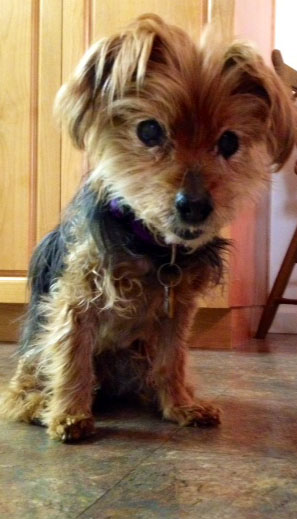



ZoieMar15

Zoie, my eighteen-year-old Yorkshire terrier, suffers from dementia.  Who knew dogs could have people diseases?  She’s deaf and blind, so when we pet her, we place our hand in front of her nose first, so she won’t be shocked when we give her “good scritches.”

On good days, Zoie walks without bumping into walls and furniture, goes to her newspapers to wait, showing us she’s ready to go outside.  On a walk through the neighborhood, she begins slowly, but picks up speed until those sniffs require her attention.

On bad days, Zoie bangs into walls, loses her balance and looks puzzled as if to say, “Why am I here?”  She’ll stand in a corner, forgetting how to back out of it.  She’ll awake from a nap and lose control of her bladder and bowels, not knowing she’s had accidents.

My heart aches for her physical and mental losses.  I already miss her knowing her time on earth is limited.  So I’m learning to appreciate each moment Zoie is in our lives, giving kisses, cuddles, pushing her nose into our hands for treats.

I’ve got one ear listening for her as I write.  She needs to go outside every two hours, except for the evening, thankfully.  I no longer write for hours at a time, forgetting where I am.  I take frequent breaks.   One friend asked how I could write with half of my usual attention.  Habit.  I now know how another friend wrote complete books on her ten minute breaks at work.

Appreciate your daily life through interruptions, work, and play.   Slow down for those good sniffs and moments of joy.

Writing Prompts:

  1.  Are you writing regularly in your life?  Creating art?  If not, make a small goal.  Write for ten or fifteen minutes a day.  Think about your creation another ten or fifteen minutes.
  2. A habit is made when you do it more than once.  How many days can you keep a good, creative habit?  Soon it will be like brushing your teeth.
  3. At the end of the day, recall three moments of sensory details you enjoyed.  What was your happiest moment?   Write about these.  You’ll soon be searching for them regularly.

laugh460

“Comedy is simply a funny way of being serious.”  Peter Ustinov

Who doesn’t love humor?  Readers, editors, and audience members yearn for it.  How would we get through the serious business of everyday life without it?  Bennett Cerf once said, “If writers want the sure road to success, for heaven’s sake, write something that will make people laugh.”

How can you make sure it’s actually funny?

According to Norman Lear in his memoir, Even This I Get to Experience, he says, “Laughter lacks depth if it isn’t involved with other emotions.  An audience is entertained when it’s involved to the point of laughter or tears—ideally both.”

Have you ever set out to write a humor scene and gone blank?  No one said comedy is easy.  A Shakespearean actor, on his deathbed said, “Dying is easy.  Comedy is hard.”

Amy Poehler from, Yes, Please, suggests, “Get out of your head.”

John Cleese discovered in So, Anyway, “an important creative principle: the more anxious you feel, the less creative you are.  Your mind ceases to play and be expansive.  Fear causes your thinking to contract, to play safe, and this forces you into stereotypical thinking. “

So exactly how do you write humor naturally?  Find your zone of creativity.  Relax.   Knowing your character, the setting and the situation will help you develop comedy intrinsically.  Ask yourself what’s weird about your topic.  Scary?  Hard?  Stupid?  Brainstorm.

Humor works when there is a setup and a payoff.  It’s what we expect to happen and what really happens.   Techniques include exaggeration, understatement, word play, satire, and parody.

Finally, remember to read what you write out loud.  Humor is all about beats and rhythm.  You should feel your comedy.   Timing is everything.

Writing Prompts:

1.  Where is humor in your life?  Everyone has funny anecdote in their lives.  Write a scene with one of your experiences.

2.  Keep a humor journal.  See something funny on the street?  Your favorite funny line in a movie or book?  What makes it funny?  Funny characters around you?  Funny things YOU do?

3.  Having a tough day?  Pretend you’re Dave Barry.  How would he turn this into a funny essay?  Write it.

4.  Use humor in your artistic projects.  Especially in the serious ones.

5.  Read humor to write humor.  And most of all, have fun!