DSC_0010

Watch the humorous video below.  After you stop laughing, write this scene from the point of view of the mailman.  Then write it from the point of view of the cat.   It may be more difficult that it looks.   Sometimes describing actions while communicating humor isn’t easy. 

http://biggeekdad.com/2014/02/mailman-vs-cat/ 


What’s a writer to do?  With so many submissions sent to editors, how can you make your writing stand out from the crowd?  Make sure you show you’re a professional? 

Don’t let your manuscript scream AMATEUR from page one!

 But how?

  1. Reduce adverbs.  Many of those pesky words which describe verbs – – many ending in “ly” aren’t necessary.  They tell and don’t show.  Rather than describe how someone does or says, show through an action.  

 Example:  “Don’t come back!” she said angrily.

Instead:  “Don’t come back!” she said, throwing a shoe at him.

Cut useless adverbs, such as very, extremely and really. 

 2.  Remove purple prose, unless you are writing romance, melodrama, or creating a satire. If writing is melodramatic and flowery, it will draw awareness to the words themselves, rather than the meaning.  The Bulwer-Lytton Contest awards writers for purposely using purple prose in order to be funny.  Note all of the adverbs in the example below. 

Example:  The 2013 winner, Chris Wieloch, from my home state of Wisconsin, has created this:  “She strutted into my office wearing a dress that clung to her like Saran Wrap to a sloppily butchered pork knuckle, bone and sinew jutting and lurching asymmetrically beneath its folds, the tightness exaggerating the granularity of the suet and causing what little palatable meat there was to sweat, its transparency the thief of imagination.”

  3.  Follow the rules.  Break them only if it’s for a specific reason

Example:  Although your grammar check will correct you for using fragments instead of a full sentence, sometimes they’re useful.  Why?  People use fragments while talking, so it’s okay to place them in dialogue. If fragments are in humor or suspense, it speeds up the pace, which increases the humor and suspense. It also provides emphasis to strengthen the meaning of words.  But use them sparingly, or the device, overdone, won’t serve its purpose any longer.

Writing Prompts:

1.  Revise your latest writing projects.  Rewrite sentences where you’ve used adverbs.  Show with action instead.

2.  Cut out your purple prose.  How can you use show don’t tell and description in a non-cloying way?  Create with poetic images which go along with your themes.   

3.  Grammar check your writing.  Go against the rules only when you have a specific purpose.

4.  Read other good, humorous entries for the Bulwer-Lytton Contest.  Write your own submission.  Have fun!

www.bulwer-lytton.com/

Do you feel you’d like to write more often, but can’t squeeze in enough time? Yearn to write better?  Feel body pain due to the time you spend at the computer or other work?

Over the years of writing, I’ve discovered some tidbits.  They save time, help me write better, and one even helps my repetitive body pain.

    1. Dictionary.com/Thesaurus.com 

 Quick, easy and free! What’s not to love about this site? 

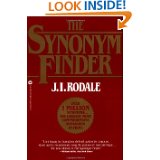
  1. The Synonym Finder by J. J. Rodale

Synonym Finder

The best thesaurus ever!  If you like one more, let me know. 

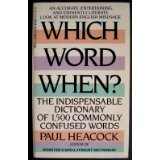
  1. Which Word When?  The Indispensable Dictionary of 1,500 Commonly Confused Words by Paul Heacock

Which Word When

Although the edition I own is from 1989, you may find one updated or different book you like in bookstores.  For those of you who shop online, a physical site is best for you really must peruse it.  Otherwise you’ll start collecting various books nearly like the one you crave, but none of them quite right.

  1. Fisher Space Pen.

 I confess.  I don’t write the rough drafts of my chapters on a machine. I handwrite my first draft on slanted knees. 

Not only do I benefit from this change of position, I climb more stairs to reach my comfy old lady’s chair or I get fresh air outside on my lounger. But the main reason I write by hand is I’m “freed” through the act of handwriting.   Ideas flow, where they might get bogged down when I face a screen.   

However, a regular pen won’t do it.  A Fischer Space Pen will write any way, any time, any where!  Its description: “A pen that can write in the air, under water, upside down, over grease, any angle.”  (You might find another brand that does the job, too.)  

Try various methods and places to write.  Which works best for you? 

  1. A writing group or writing partner.

Probably the most important item on this list.  It won’t break your pocketbook either.  My writing partner and I meet every two weeks to share our work, discuss craft, and support one another.  My writing group meets once a month to do the same.  I’m fortunate every member is a good writing with terrific critiquing skills. 

Writing Prompts:

  1. Switch your writing habits.  If you’ve been composing only on a computer, try writing by hand.  Give it some time and see if this allows your mind to wander and discover the right words, more depth of character, and fresh ideas.  If you’ve been writing by hand, give it a go on a computer or typewriter.  Discover what works for you!
  2. Switch places.  Do you write in a home office?  Try a park, café, or your backyard.  Maybe an airport, the library, or your car will spark your best work. 

Park

Cafeairport

Park3. Do you always start writing from the beginning?  Attempt your next project by starting in the middle, or towards the end.  Begin with the major conflict, an emotional scene, or a hidden secret.  Do any of these propel you forward more than starting at chapter one?

4. Write at different times of the day for a week.  Have you learned anything about yourself?


Hollywood Producer/Agent Marilyn Atlas led an excellent writing workshop where focused on character.  She gave a multitude of terrific writing tips and I’ll share one of them.  She discussed three reasons characters resonate with readers or viewers.

The characters are:
1. fascinating or
2. mysterious or
3. relatable 

Writing Prompts:

1. Study a memorable character in literature or film.  Is this person fascinating?  If so, how?  Mysterious?  Explain.  Can you relate with her/him?  What makes him/her relatable?
2. What about the piece you are composing now?  If your protagonist isn’t fascinating, mysterious or relatable, invent back story and layers so he/she will be compelling. 
3. Before you write your project, spend time crafting your characters.  Draft scenes of conflict.  Every page should have tension, which can be done in subtext.
4. What is subtext?  Express characters through dialogue about one thing, while under their words remain an underlying meaning. 


“Just forty-five minutes a day,” assures the author of a book on meditation.
Of course I begin my day with this, so as not to forget to meditate. It should help me quiet my mind at night so I’ll sleep soundly.

“An hour of aerobic activity each day,” the exercise guru and well-known doctor advises.
Following my brisk walking workout, I shower and condition my hair with coconut oil.

“Leave it in for 15 minutes,” suggests the hairdresser. “Then wash, dry, and style.”
Blow-drying long hair sure takes awhile.

“Vacuum your carpet daily,” says the carpet sales associate. “It will last longer.”
What a lot of carpet we own.
I finish at last.

For breakfast, I add the recommended flax and Chia seeds to the blender with my yogurt.
“Eat this in the morning all the time,” suggests the nutritionist in her popular book for optimum health.

I down the vitamins recommended by my chiropractor.
“Drink lots of water,” he tells me.
With all the water I’m drinking, I spend more time in the bathroom.

Speaking of bathrooms, my seventeen-year-old Yorkie needs a walk and frequent trips out to the backyard. She no longer is able to get down from the chair where she sleeps and cries when she needs “off.” I race up and down stairs at least seventeen times a day.

“Avoid preservatives,” says an organic farmer.
This requires me to make all of our food from scratch, and grow what we can in our backyard.

“Create posts on Facebook, your blog, and social media,” says a well-known book publicist at a writing conference I recently attended. “Update your web site; make book trailers and your own videos.”
I must LEARN how to do these things first, which for me, takes FOREVER.

Then there’s the laundry, errands, housecleaning and gardening I must catch up on since my recent trip to the conference set me back on my multitude of chores.

I turn on the oven and prepare dinner from the basics. No time-saving remedies, as we don’t eat preservatives, remember?

“Write letters to bond with people and brighten an older person’s day,” my mother cemented in my memories and lifestyle.

I owe three elderly women letters, and get well cards to several friends. It’s flu season.
And speaking of writing . . .

“Set goals for your writing,” I read many years ago.
After three pages of those goals, my emotional energy is draining.

“Make writing your primary activity.”
Of course! It’s number one!

But wait.

Darkness settles around me. I yawn and stretch. If I write now, my mind won’t be able to shut down to sleep.
It will make my insomnia worse.

Do I have time to meditate before Zoie needs her evening walk?

<strong>Writing Prompts:</strong>

1. Set YOUR writing goals. If there are too many which may overwhelm you, create a daily or weekly “to do” list.

2. Make your writing a priority. When is your best time to write well? Carve out time within your day or week, which depends upon your goals.

3. Write! Don’t answer the phone or the door. Make sure members of your household know not to interrupt unless the house is on fire.

4. Can’t write?  Relax and wonder (NOT worry) about your project. Let your mind daydream about a character, setting, or plot problem will help you move forward.

5. Don’t be concerned about the number of words, pages, or chapters.  Some projects/chapters/poems take more time than others.

6. Writing not your best?  Rewriting is terrific! 

7. Always take time to write thank you notes. And comments on blogs. They are appreciated.

 

Benjamin Franklin says it all: “I have already made this paper too long, for which I must crave pardon, not having now time to make it shorter.” Henry David Thoreau wrote, “Not that the story need be long, but it will take a long while to make it short.”

The most common question which pops up in various contests I’ve judged, is: “My story is longer than the guideline’s length. May I submit it all?”

No! Writing short requires a much-needed skill. Revise so your story is written succinctly.

Below is advice on writing a short story of 100 words. It can be applied to all stories.

My favorite tidbit is this: “Think of the story in terms of a question and answer.”

Your answer will become the plot of your story. But brainstorm lots of options! If it’s too easy, your option may be too convenient.

http://www.rdasia.com/how-to-write-story-100-words

Writing Prompt:
1. Take a story you’ve written and tighten it. Can you cut out 100 words? More? Once you challenge yourself, the process can be fun and addicting!
2. Read your story aloud. Where have you “told” information? Can you show it with an action verb instead?
3. Choose a poem you’ve created and do the process of #1 and #2. Is the end result more vivid?

Cutting out vague words sharpens your writing and respects the reader to make conclusions. Use this new technique with all of your writing!

I turned the page of my book, soaking in the story, silence, and reveling in peaceful solitude. Not total solitude, since my Yorkie, Zoie’s rhythmic breathing relaxed me as she slept in my lap.

MOO!

Straightening up with a jerk, I woke my deaf dog.

What was a mooing cow doing INSIDE this room?

Could it have been from an electronic device? Perhaps my husband neglected to take his phone with him. I smiled at the irony of this sound in my suburban California home. Maybe Dad was saying hello from the other side? He spent the first half of his life farming with dairy cows in southeastern Wisconsin, and as a baby and toddler I lived on that family farm, too. Hi Dad, I thought, glad he’d retained his sense of humor.

As I settled back into my story, Zoie, reassured by my calm demeanor, snoozed again.

MOO!

The realistic animal sound came from our family room cupboard. I got up to investigate. Nothing in the stacks of paper, pens, and recipes gave a hint to the mystery. Old video tapes didn’t look as though they’d moo, either. But when I reached Zoie’s dog toys, I knew the puzzle’s answer. A black and white fabric ball must contain the noisemaker. Although it hadn’t worked in years, and I didn’t know it had held a noise device when I threw it in the washing machine, that process could have reactivated it.

Or.

Dad greeted me.

I prefer this answer.

Whenever we try to make this ball produce sound effects, nothing happens. But on its own . . .

MOO!

Writing Prompts:

1. What signs or symbols can you discover within the book you’re reading? Through their repetition, what is its underlying meaning?
2. What sign or symbol can you develop within the project you’re writing? Through carefully placed repetition, your motif may strengthen your theme, characters, and/or plot.
3. Create an artistic representation of your symbol. How does it relate to you? Perhaps this may become another layer of its meaning.

While examining tide pools at the coast, I hopped from one wet, slippery rock to another. Down I fell . . . Bam!

As I lay on my back in the water and stones, pain throbbed from my knees, legs elbow and back. But relief did too. Nothing was broken. Within seconds, Bob stood above me, screaming.

“Get up! Get up! Get up!”

Starring into the blue sky, I reassured him. “I’m fine, really. Water seeped from the tide pools into my clothes. My back felt each stone and rock.

“Get up! Get up! Get up!”

“Bob, I just can’t pop up. I need a moment.”

A wrinkled face appeared on the opposite side of where Bob stood. “Take your time,” said the stranger, his voice soothing me and my anxious husband. “There is no rush.”

Then I noticed a crowd gathered around me. Many sets of eyes peered down. I could imagine their thoughts. “Would she get up? Do we call an ambulance?” As white clouds floated by I wondered if this was similar to a death watch. Then another strange thought popped through my aches. Did I hurt any marine life in the tide pools below me?”

Perhaps I groaned as I steadied myself into a sitting position before rising.

“Shall I take I take you to the hospital?” Bob said.

“I’m fine,” I said. “Just banged up.”

Later, while recounting the incident, Bob said, “I yelled ‘Get up?’ Really?”

And me? Bruised and battered, I walked with a ‘hitch in my get-up’ as my Aunt Mary would have described. My knees and shins swelled to twice their normal size. My entire legs looked like I had been in a boxing ring.

But.

I was fine.

Writing Prompts:

1. Write about two characters in a traumatic scene. How do each of them react?
2. Take that scene and slow-down-the-moment, using your senses. Over-write the piece!
3. Next, choose the best tense. (Past? Present? Future?) As you rewrite, choosing which senses are the most important, and verbs which are active.

“If they give you ruled paper, write the other way.” Juan Ramon Jimenez

In kindergarten, my son’s teacher gave each student a construction paper Christmas stocking along with decorations. Their assignment? Cut them out and glue them too look like her example.

A couple other mother-volunteers and I entered the room while teacher and class were on the playground for recess.

“Look at all their stockings,” said one mom.

Each stocking was hung, identically in a row along the wall. They could have been mimeographed in their sameness.

“Wow,” said the other mom, observing one stocking decorated with magic marker Christmas figures on the tiny white edge of the stockings’ perimeter.
“Who did that one?” said the first mom.
They peered closely at the small signature.
It was Tofer.

I write this anecdote not to brag, but to show how one five-year-old figured a way to be creative even with a cut and paste assignment.

How will you show your individuality with your writing or art?

Writing Prompts:
1. Select one of your scenes you’ve already written. How can you make it yours and only yours?
2. Make one of your characters quirky. What distinguishes this character from every other one in your book? A particular secret, trait, or passion may allow her to be amusing or annoying or lovable!
3. Create a setting that shows its character. Being specific creates identifiable reactions and emotions within your readers. Can you show nostalgia? A comfort setting? A suspenseful place? Remember sounds, smells and even tastes will allow your readers to feel like they are there.

Thanks to Rich Freedman of the (Vallejo) Times-Herald, word has spread about a youngster who channeled her anger into writing.

Diagnosed with leukemia this past year, ten-year-old Monica Romo wrote an essay detailing how “Wonder Woman” (Monica!) would rid Vallejo, in Northern California, of hate and evil. In her City Hall appearance, 125 people shared her hope. Receiving a Solano Hero’s Certificate, Monika received a Solano Hero’s Certificate.

Congratulations, Monika!

Writing Prompts:

1. Use your passionate feelings about an issue to inspire art or writing. How will you choose to express yourself? Which cause incites your emotions?

2. Pretend you are a superhero. Write a graphic novel or comic strip expressing your passion for change.